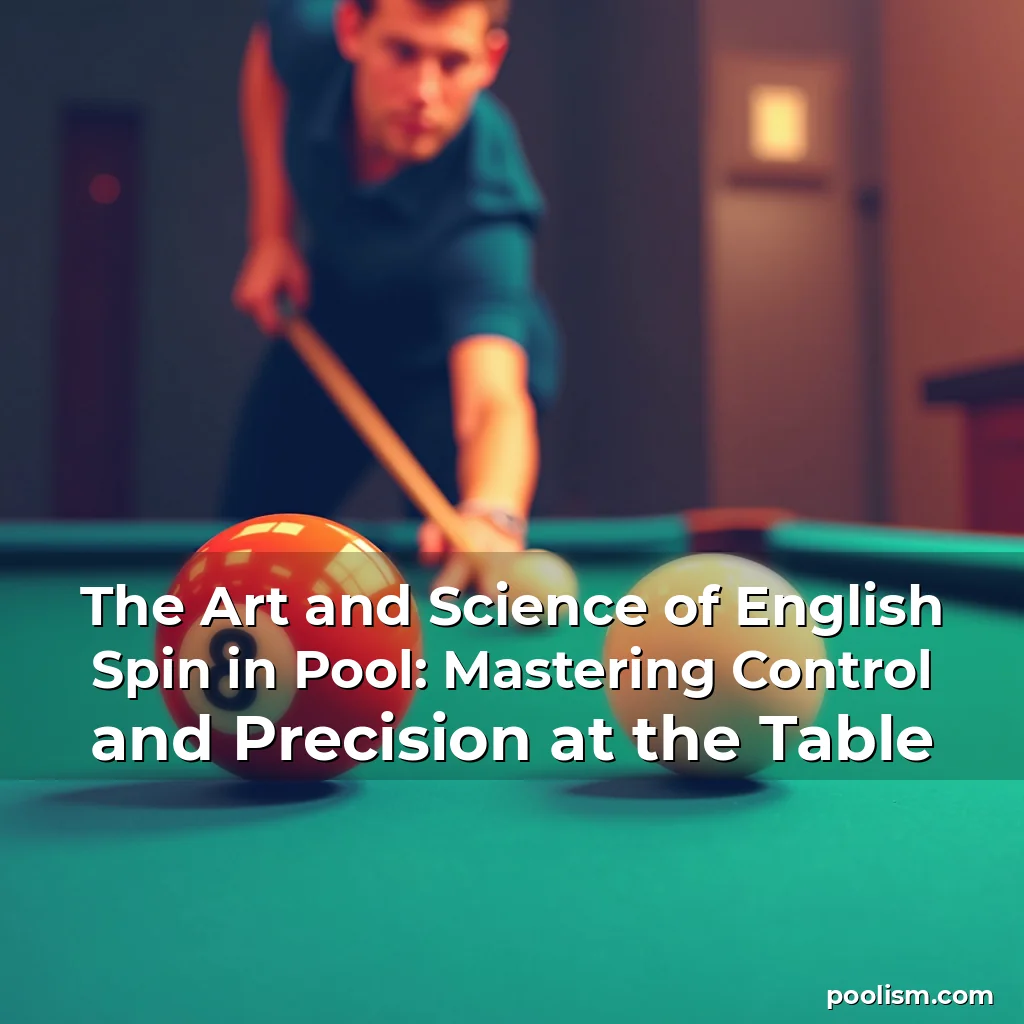
The Art and Science of English Spin in Pool: Mastering Control and Precision at the Table
English spin is one of the most nuanced and powerful techniques in cue sports, allowing players to manipulate the ball’s trajectory after contact. By applying side spin through careful control of the cue tip during impact, skilled players can create dramatic effects that alter pocketing angles, enable trick shots, and even influence the motion of other balls on the table.
This guide explores how to effectively apply and utilize English spin in various game scenarios, from basic shot-making to advanced positional play. Whether you’re a beginner looking to understand its fundamentals or an experienced player seeking refinement, mastering English will elevate your overall performance at the pool table.
Understanding the Mechanics of Side Spin Application
The foundation of successful English application lies in understanding exactly what happens when you strike the cue ball off-center. When the tip contacts the ball away from its central axis, it imparts rotational energy that causes the ball to curve along its path once it begins rolling across the cloth.
This rotation doesn’t simply make the object ball move sideways; rather, it creates complex interactions between the spinning ball and the playing surface itself. The friction between the ball and the table cloth translates some of this rotational energy into lateral movement while maintaining forward momentum.
- Tip position determines spin direction: Striking left of center applies right-side English, while striking right of center applies left-side English
- Amount of spin depends on contact point: A shallow cut (i.e.. close to the edge) generates more extreme spin than hitting closer to the center
Types of English Spin and Their Applications
In professional pool play, different types of English are used strategically based on shot requirements. Inside English refers to applying spin toward the direction of travel, which helps maintain line-of-sight visibility when shooting around obstacles.
Outside English involves applying spin opposite to the intended direction of travel, often used for bank shots where predictable rebound trajectories are critical. Hybrid applications combine both inside and outside elements depending on precise positioning needs.
Differentiating Between Natural vs. Artificially Induced Spin
Natural roll occurs when a ball maintains consistent curvature due to inherent physical properties. However, artificially induced English allows players to precisely control these curves by manipulating their stroke technique and tip placement at contact.
Modern research shows that optimal English application requires matching the amount of spin applied to the actual distance traveled by the ball post-contact. This ensures predictability without excessive skidding or unpredictable behavior.
Techniques for Applying Effective English Spin
Mastery over English demands refined control of several key factors including grip pres Practicing controlled strokes with deliberate tip placement builds muscle memory essential for reliable execution under pressure situations.
Bridging too high or low affects how straight your shot remains, so finding an optimal height that matches your natural stance is crucial. Consistent practice routines help develop the fine motor skills required to consistently hit desired spots on the cue ball.
- Use a low bridge for better accuracy: Lower bridges provide greater stability but may require adjusting your body angle slightly
- Vary your grip tension: Too tight makes it harder to achieve smooth follow-through, while too loose reduces control
Strategic Uses of English in Shot Making
Skillful use of English opens up creative shot options not available through conventional aiming alone. It enables players to navigate difficult layouts by altering ball paths unexpectedly yet controllably. In tournament settings, this ability often separates top-tier competitors from average players.
For example, using right-hand English on a long rail shot can cause the cue ball to hook back toward its original position after contacting the object ball, creating opportunities for immediate second-ball shots without needing to reposition first.
Common Mistakes in English Application
Failing to account for speed and distance relationships leads to inconsistent results. Many beginners mistakenly believe that faster shots produce stronger spin effects, but physics tells us otherwise – higher speeds actually reduce effective spin transfer.
Overestimating the power of English also causes problems. While useful, excessive spin can lead to erratic bounces or unintended deflections. Learning when to use minimal versus maximal English is part of developing tactical judgment.
- Underestimating speed-spin relationship: Slower shots allow for more efficient spin transfer despite shorter distances covered
- Ignoring directional compensation: Left-right balance must be carefully maintained when using cross-table English applications
Training Drills for Developing English Proficiency
Cue ball tracking exercises build visual awareness necessary for accurate English application. Using colored markers placed around the table helps train eyes to recognize subtle differences in ball rotation patterns before they become visible visually.
Repeatable pattern drills reinforce muscle memory through repetition. Shooting identical setups multiple times with slight variations teaches how small adjustments affect final outcomes dramatically.
- Practice corner-to-corner English transfers: This develops precision in controlling how much spin gets transferred onto target balls
- Work on stop shot variations: These teach how to negate unwanted spin carry-over effects accurately
Advanced Concepts in English Manipulation
Combining English with elevation changes introduces another dimension of complexity. Players can adjust their stroke height relative to the cushion level to modify how spin interacts with different parts of the ball surface.
Mastering such combinations requires deep understanding of physics principles related to angular momentum and torque distribution within spherical objects moving across inclined surfaces.
Torque Distribution and Angular Momentum Principles
When a cue ball rotates while traveling down a lane, it experiences forces that change according to its orientation. Understanding how weight distribution affects spin characteristics becomes vital for predicting exact trajectories especially near rails or cushions.
Experiments conducted with high-speed cameras show that slight variations in initial spin application can significantly alter how balls behave upon collision with walls or other balls mid-air during jump shots.
Equipment Considerations for Optimal English Performance
The type of cue shaft directly influences how well English can be imparted and maintained. Shafts made from materials like maple or carbon fiber offer different feel characteristics affecting tip responsiveness during strikes.
Cue tips vary widely in hardness and composition, each impacting how efficiently spin can be transferred. Softer tips generally provide better spin potential but wear out quicker compared to harder alternatives designed for durability over time.
- Shaft stiffness affects tip response: Stiffer shafts transmit vibrations more clearly, aiding feedback sensitivity
- Tip material choice matters: Leather provides traditional feel while synthetic options offer enhanced durability
Evaluating Your Progress in English Mastery
Keeping track of improvement through video analysis reveals subtle technical flaws invisible during live gameplay. Reviewing recordings lets you observe things like follow-through alignment and tip contact points with greater clarity.
Setting measurable goals improves motivation levels considerably. Tracking metrics like percentage of successfully executed English-based shots gives clear indicators of skill development progress over weeks/months.
- Record regular training sessions: Video logs serve as invaluable tools for self-assessment and correction
- Create performance benchmarks: Set realistic targets aligned with current proficiency levels
Conclusion
Mastering English spin transforms simple pool shots into strategic masterpieces requiring both technical precision and intuitive decision making. With dedication to practicing fundamental techniques alongside continuous learning about underlying mechanics, any serious player can reach new heights of competence.
To begin improving today, focus on refining your stroke consistency first then gradually introduce targeted English drills. Remember that mastery comes through patience, persistence, and willingness to analyze every aspect of your performance critically.